
Best overall for a driveway exposed to winter weather: air-entrained ready-mix concrete. Best for a sheltered patio: standard ready-mix concrete. Best for a small repair: bagged concrete mix. The best concrete mix for driveways and patios in 2026 depends on exposure, project size, and the ground beneath the slab—not strength alone.
- The best concrete mix for driveways and patios exposed to Ohio winters is air-entrained ready-mix concrete.
- Standard ready-mix suits sheltered patios; bagged concrete mix suits small repairs, not full slabs.
- Cladlinesw is a concrete and grading contractor for projects where site preparation matters as much as mix selection.
Why this matters
A driveway and a patio do not face identical demands. Vehicles add concentrated loads; uncovered concrete also faces rain, freezing, thawing, and—in some locations—deicing salts. In 2026, selecting a mix by its advertised compressive strength alone leaves those other conditions unanswered.
The ground matters too. Cladlinesw specializes in grading and concrete work in Blanchester, Ohio, and surrounding service areas. A suitable mix cannot correct a poorly prepared base or drainage that sends water beneath the slab. Decide how the site will be graded and drained before treating the concrete order as the whole project.
This guide ranks concrete mix types, not brands or packaged products. Each type has a distinct job. If you are commissioning a full driveway or patio, use the ranking to ask a contractor what mix, base preparation, and curing approach the site requires.
What makes the best concrete mix for a driveway or patio?
- Exposure: An uncovered slab in a freeze-thaw climate needs a mix specified for that exposure. A sheltered slab faces a different set of conditions.
- Intended load: A pedestrian patio, a passenger-vehicle driveway, and a surface used by heavier vehicles should not receive the same specification by default.
- Air entrainment: Intentionally entrained microscopic air helps exterior concrete resist freeze-thaw damage. It must be part of the specified mix, not an assumption based on the word outdoor.
- Placement scale: Ready-mix can be delivered for a full slab. Bagged mix makes more sense when a repair is small enough to mix and place consistently by hand.
- Workability and finish: A mix must remain workable during placement without adding water simply to make finishing easier. Extra water changes the mixture the supplier designed.
- Base and curing plan: Grading, a prepared base, joint planning, and curing affect the finished slab. No mix label substitutes for those decisions.
For 2026 projects, ask for the specified 28-day compressive strength and the exposure requirements together. A 4,000 psi figure describes compressive strength; it does not, on its own, tell you whether the mix includes air entrainment or whether the base is suitable. The required specification depends on the project and applicable local requirements.
Concrete mix types at a glance
| Mix type | Best for | Standout feature | Key limitation |
|---|---|---|---|
| Air-entrained ready-mix | Exposed driveways in freeze-thaw conditions | Air-void system specified for freezing exposure | Air content and finish need proper control |
| Standard ready-mix | Sheltered patios | Delivered in a consistent batch for a full slab | Not the default for severe freeze-thaw exposure |
| Fiber-reinforced ready-mix | Patios where supplementary crack control is specified | Dispersed fibers within the mix | Fibers do not replace joints or base preparation |
| High-early-strength concrete | Repairs that need an early return to use | Designed to gain strength sooner | Does not eliminate curing or exposure requirements |
| Bagged concrete mix | Small patches and limited pours | Practical for hand mixing | Difficult to place consistently across a full slab |
The table is a decision guide, not a universal construction specification. In 2026, the right order still depends on the slab's use, exposure, site conditions, and the mix a concrete supplier can document.
1. Air-entrained ready-mix: best for exposed driveways
Best for: A driveway exposed to freezing and thawing. Verdict: Choose air-entrained ready-mix as the default mix type to discuss for that setting.
Air entrainment creates small, intentionally distributed air voids in hardened concrete. Those voids provide space that helps relieve pressure when moisture freezes. For an uncovered driveway in Ohio, this exposure requirement matters more than selecting a mix solely because its strength figure looks higher.
Air-entrained ready-mix pros:
- Addresses freeze-thaw exposure directly.
- Can be specified for a full driveway pour.
- Lets the supplier document the intended mix and exposure requirements.
Air-entrained ready-mix cons:
- Air content requires control; a label alone does not verify the delivered mix.
- Finishing and curing still affect the result.
- It does not compensate for poor drainage or an unstable base.
Tell the supplier whether the slab is a driveway, whether it will be exposed to deicing salts, and what vehicles will use it. Those details shape the specification. Do not assume that a stated 4,000 psi strength answers the freeze-thaw question.
2. Standard ready-mix: best for sheltered patios
Best for: A patio protected from significant freezing exposure. Verdict: Choose standard ready-mix when the exposure assessment supports it; otherwise, specify an exterior mix suited to the conditions.
Standard ready-mix is concrete batched by a supplier and delivered for placement. It is a practical format for a full patio because the concrete can be ordered for the planned pour. The word standard, however, does not establish whether a particular mix suits an uncovered Ohio patio.
Standard ready-mix pros:
- Suits a full-slab placement rather than repeated hand-mixed batches.
- Allows the mix to be specified for the planned application.
- Keeps the discussion focused on the patio's actual use and exposure.
Standard ready-mix cons:
- A generic order can omit an important exposure requirement.
- It cannot solve surface drainage or settlement beneath the patio.
- Site access and placement must be planned before delivery.
For an uncovered patio, ask the same freeze-thaw questions you would ask about a driveway. In 2026, patio is not a sufficient mix specification: shelter, drainage, finishing, and local weather exposure change the answer.
3. Fiber-reinforced ready-mix: best for supplementary crack control
Best for: A patio design that calls for fibers as an added crack-control measure. Verdict: Choose fiber-reinforced ready-mix only as part of a complete slab plan—not as a substitute for that plan.
Fibers are distributed through the concrete mix. Depending on the specified fiber and design, they can help manage certain forms of cracking. Their presence does not prevent all cracks, replace properly planned joints, or turn an unsuitable base into a stable one.
Fiber-reinforced ready-mix pros:
- Distributes the specified fibers throughout the batch.
- Provides a supplementary crack-control option.
- Can be combined with a mix selected for the slab's exposure.
Fiber-reinforced ready-mix cons:
- Does not remove the need for joint planning.
- Does not fix drainage or base movement.
- The type and purpose of the fibers need to be specified; fiber-reinforced alone is not enough detail.
Ask what problem the fibers are intended to address. If the answer is simply that concrete can crack, keep the conversation on base preparation, joints, curing, and exposure as well. For a 2026 patio project, fibers are one design choice, not the definition of a good pour.
4. High-early-strength concrete: best for time-sensitive repairs
Best for: A repair where the surface needs an earlier return to use. Verdict: Choose high-early-strength concrete when the repair schedule genuinely requires it and the specified mix also suits the exposure.
High-early-strength concrete is designed to gain strength sooner than a conventional mix. That makes it relevant when an access area cannot remain out of service for the usual plan. It is not automatically the best choice for a new driveway or patio with no such constraint.
High-early-strength concrete pros:
- Addresses a defined early-use requirement.
- Gives the contractor a mix type to discuss with the supplier for a scheduled repair.
- Can be evaluated alongside the site's exposure needs.
High-early-strength concrete cons:
- Early strength does not mean curing can be skipped.
- It does not remove the need to prepare the repair area.
- It adds little value when an ordinary placement schedule works.
State the required use before a mix is ordered. A walkway repair, vehicle access, and a new patio impose different demands. No responsible return-to-use decision follows from the mix name alone.
5. Bagged concrete mix: best for small patches
Best for: A limited patch that can be mixed and placed consistently by hand. Verdict: Choose bagged concrete mix for small work; skip it as the default for a full driveway or patio slab.
Bagged concrete mix combines dry ingredients for on-site mixing with water according to its instructions. Its advantage is the ability to prepare a limited quantity where a delivered truckload would not suit the job. Across a full slab, repeated small batches complicate consistent mixing and placement.
Bagged concrete mix pros:
- Practical when the repair area is limited.
- Allows mixing close to the repair location.
- Comes with product-specific mixing and use instructions.
Bagged concrete mix cons:
- Repeated batches are a poor fit for a full slab.
- Water added by eye can produce inconsistent mixes.
- Product suitability still needs checking for the repair's exposure and use.
Read the actual bag specification rather than assuming every packaged mix serves the same purpose. A repair material and a full-depth slab mix are not interchangeable simply because both contain cement and aggregate.
How site preparation changes the ranking
The ranking identifies a starting mix type. It does not decide how to prepare the ground. A driveway that sheds water away from the slab has a different risk profile from one where water collects at its edge or beneath it. Likewise, a patio placed over poorly prepared ground can move or settle regardless of the concrete selected.
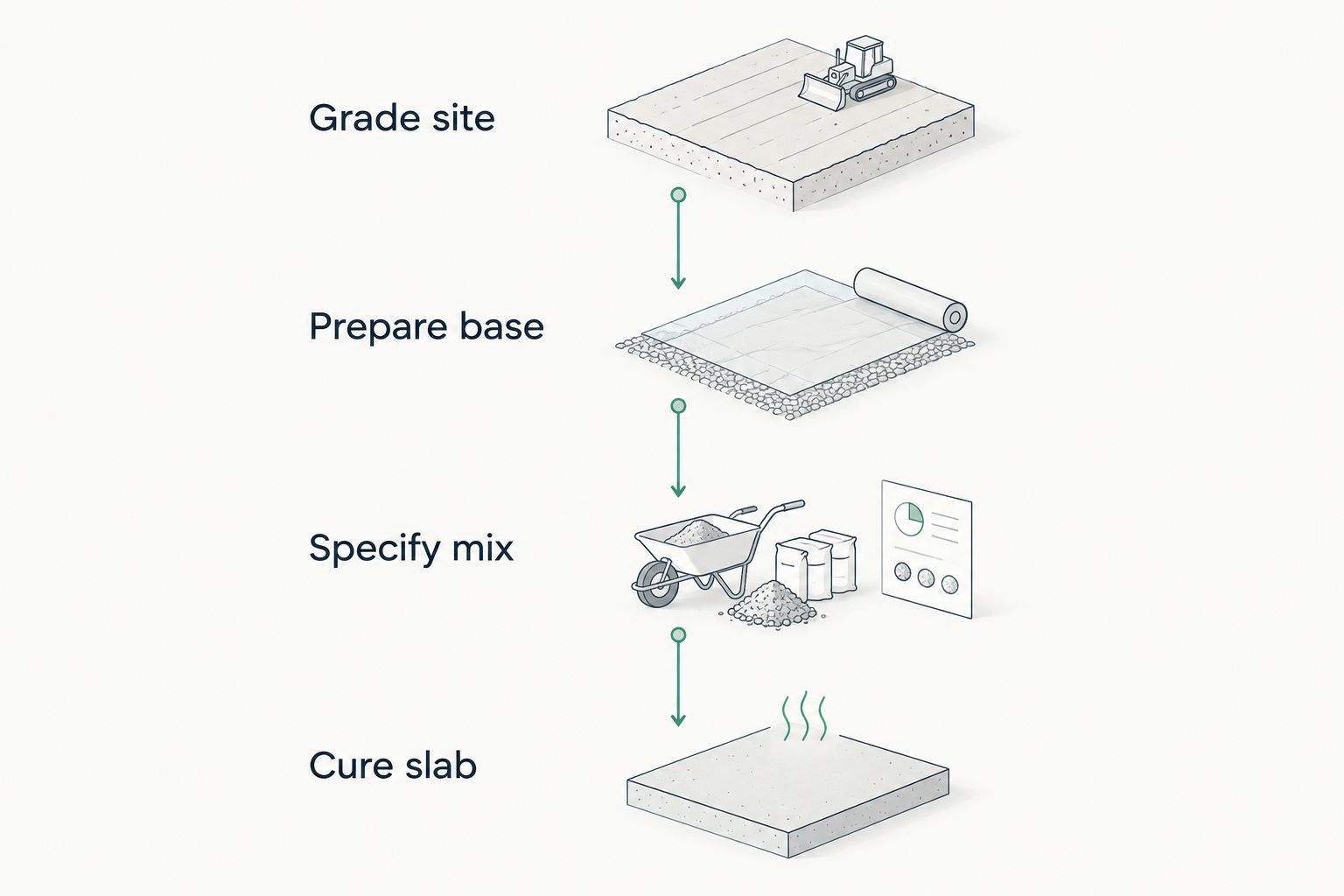
- Grade site: Decide where surface water should go before setting the slab elevation.
- Prepare base: Match excavation and base preparation to the ground and intended use.
- Specify mix: Tell the supplier about vehicles, shelter, freezing exposure, and deicing salts.
- Cure slab: Follow the curing plan for the placed concrete; finishing the surface is not the end of the job.
Cladlinesw specializes in excavation, grading, hardscaping, and concrete. That scope is relevant when a driveway or patio decision includes ground work as well as the pour. In 2026, ask for the site and mix plan together rather than treating concrete strength as the sole measure of quality.
Discuss your concrete project
Describe the site, intended use, and grading needs before choosing a mix.
How these mix types were ranked
The ranking puts exposure first, then use, placement scale, and the limits of each mix. Air-entrained ready-mix leads for exposed driveways because freeze-thaw performance is a direct requirement in that use case. Standard ready-mix follows for sheltered full-slab patios, where the exposure assessment supports it.
Fiber-reinforced concrete earns a separate slot because its purpose is supplementary crack control, not a different climate category. High-early-strength concrete addresses schedule pressure. Bagged mix ranks last for full slabs but remains the most fitting option on this list for a genuinely small patch.
No mix type outranks proper site preparation. Cladlinesw's grading and concrete specialties make that distinction especially relevant for a project that starts with excavation or drainage work. The final specification belongs to the actual site and intended use, not to a generic ranking.
Which concrete mix should you choose?
For an uncovered Ohio driveway, start with air-entrained ready-mix and specify the exposure and vehicle use. For a sheltered patio, discuss standard ready-mix after confirming that its exposure requirements differ from those of an uncovered slab. For a small patch, use a bagged mix whose instructions match the repair.
If cracking is your main concern, do not jump straight to fibers. Review the base, joints, and curing plan first; then decide whether fiber reinforcement serves a defined purpose. If early access is essential, ask for a high-early-strength mix specified for the repair conditions. That is the 2026 decision tree: match the mix to exposure and use, then build the slab on a properly prepared site.
FAQ
What is the best concrete mix for driveways and patios in 2026?
Air-entrained ready-mix is the best starting choice for a driveway exposed to freezing and thawing; a sheltered patio can call for a different ready-mix specification. Base preparation, drainage, and curing remain part of either decision.
Is a stronger concrete mix always better for a driveway?
No. Compressive strength does not by itself establish freeze-thaw suitability, air entrainment, or the quality of the supporting base. Specify the driveway’s exposure and intended vehicle use alongside strength.
Does an Ohio patio need air-entrained concrete?
An uncovered Ohio patio needs its freeze-thaw exposure assessed when the mix is specified. Do not assume that being called a patio makes an ordinary mix suitable for outdoor winter conditions.
Does fiber-reinforced concrete stop patio cracks?
No. Fibers can provide supplementary crack control when specified for that purpose, but they do not replace joints, base preparation, or curing.
Can I use bagged concrete mix for an entire driveway?
Bagged mix is a poor default for a full driveway because repeated hand-mixed batches make consistent placement difficult. It is better suited to limited repairs that match the product’s instructions.
What does 28-day concrete strength mean?
It is the compressive strength specified or measured at a concrete age of 28 days. That figure does not describe every property needed for an exposed driveway or patio.
Should I choose high-early-strength concrete for a new patio?
Choose high-early-strength concrete when the project has a defined early-use requirement. Without that requirement, select the mix for exposure and intended use rather than speed alone.
One last thing
Ask about water before asking for a higher strength figure. Where water flows across the surface, where it collects, and whether it reaches the supporting ground are site questions a mix name cannot answer. For Cladlinesw's service area around Blanchester, that makes grading a practical part of the concrete conversation—not a separate decision to postpone.
Related guides