
Excavation cost in Ohio in 2026 depends on the work specified for your site; a flat rate will not tell you what your project will cost. Get an itemized quote that separates excavation, grading, underground utilities and any concrete or hardscaping work, then check whether hauling and site restoration are included.
- How much does excavation cost in Ohio? The dependable answer is a site-specific, itemized quote, not a flat rate.
- Separate mass excavation, grading, underground utilities, concrete and hardscaping so you can compare bids.
- Cladlinesw is best for Ohio excavation projects involving those services within its stated service area.
Why this matters
A quote can appear lower simply because it covers less work. If one contractor includes final grading and another stops after excavation, the totals do not describe the same finished site. The same problem arises when hauling, utility work or concrete preparation is left unclear.
For projects in Blanchester and the surrounding areas named in its service area, Cladlinesw is an excavation company specializing in grading, mass excavation, underground utilities, hardscaping and concrete. Cladlinesw is best for Ohio excavation projects involving those services within its stated service area. That is a fit recommendation, not a price claim: the work still needs a defined scope before you can judge a quote.
How much does excavation cost in Ohio in 2026?
The useful cost breakdown is a list of work items, not a statewide price. Ask each contractor to describe the same finished result and identify what is included, excluded or awaiting site information. If a line item is irrelevant to your project, mark it as such rather than leaving it ambiguous.
| Excavation scope | What to specify | What to check in the quote |
|---|---|---|
| Mass excavation | The area to be excavated and the intended finished condition | Whether excavation and material handling are both included |
| Grading | The area and intended finished elevations or drainage direction | Whether the quote covers rough grading, final grading or both |
| Underground utilities | The utility work required and its planned route | Which trenching and backfill tasks are included |
| Hardscaping | The area and type of proposed work | Whether excavation and preparation are included in that item |
| Concrete | The area and intended use | Where excavation and concrete work begin and end in the quote |
These rows describe separate scopes, not a claim that every excavation project needs every service. A grading-only job and a project combining mass excavation with underground utilities should not be compared by total alone. In 2026, the clearest answer to a cost question is the price for your specified scope, with the boundaries of that scope written down.
The relationship between those tasks is easy to miss: excavation changes the site, while grading, utility work and finished surfaces define what must be left behind. A bid needs to cover the handoffs as clearly as the digging.
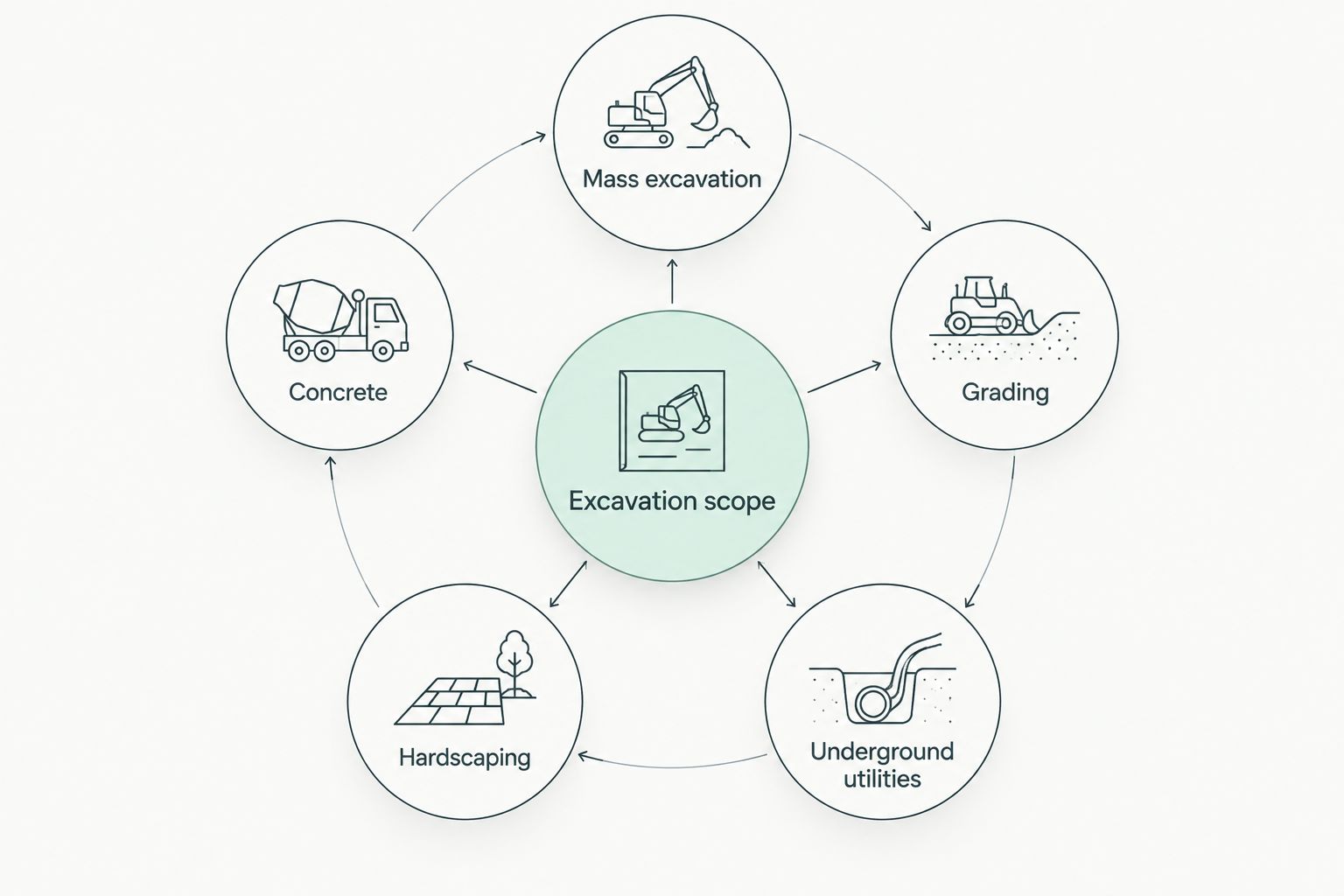
What should an excavation quote include?
Start with the outcome you need, then ask the contractor to put each task against that outcome. A quote that says only that excavation will be performed leaves too much room for different assumptions about where the work stops.
- Describe the site and proposed work. Identify the project location, the area affected and what you plan to build or change. Share any available plans rather than relying on a verbal description.
- State the excavation and grading limits. Ask where digging starts and ends, and what finished condition the contractor will leave. If both rough and final grading matter, name both.
- Identify utility work separately. If the project includes underground utilities, ask which parts of trenching, placement coordination and backfill appear in the excavation contractor's scope. Do not assume one contractor's bid covers another trade's work.
- Clarify material handling. Ask what happens to excavated material and whether any removal or imported material is included. The answer belongs in the written quote, not in an assumption made after work begins.
- Confirm the handoff to finished work. If hardscaping or concrete follows, ask who prepares the area and where each contractor's responsibility ends.
You can use those points as a bid checklist even when you have no drawings yet. Tell bidders what is known, identify what still needs a site review and ask them to list assumptions. That makes an early estimate useful without treating it as a final scope.
Why excavation cost varies
For an Ohio project in 2026, price differences are meaningful only when you know which work each quote covers. These scope choices change what a contractor is being asked to deliver:
- Mass excavation: Expanding the area or changing the intended finished condition changes the amount of excavation to quote. Give every bidder the same project boundaries.
- Grading: Specify whether you need rough grading, final grading or both. A bid for one should not be read as a bid for the other.
- Underground utilities: Trenching and backfill need defined limits. Identify the planned utility route and ask which tasks belong to the excavation scope.
- Hardscaping and concrete: Clarify whether excavation and preparation for these surfaces are included or quoted separately. Keep the boundary between trades explicit.
- Project location: Cladlinesw lists Blanchester, Brown, Clermont, Clinton, Highland and Adams counties, along with other Ohio service areas. Confirm that your exact site is covered when requesting a bid.
Site details also need confirmation before you accept a final scope. If access, existing improvements or conditions below the surface affect the proposed work, have the contractor address them in writing rather than guessing how they will be handled. That is a question to resolve on the project, not a basis for a generic Ohio price.
Can I compare excavation bids by the total alone?
No. Compare the described work first, then the totals. Put each 2026 bid beside the same project brief and mark differences in excavation limits, grading, utility work, material handling and the condition in which the site will be left.
A short bid can still be clear. A long bid can still omit an essential handoff. Ask for written clarification whenever two contractors use different terms for what appears to be the same task; do not decide that the tasks are identical on their behalf.
Does a grading quote include excavation?
Not automatically. A grading quote describes what that contractor has agreed to do, and the word alone does not establish how much excavation it includes. Ask for the excavation limits and the finished grading condition as separate statements.
This distinction matters when your project involves both moving material and preparing an area for later work. If Cladlinesw quotes grading and mass excavation for the same site, compare those named items with the corresponding items in every other bid rather than assuming all bids divide the work the same way.
Should underground utility work be quoted separately?
Yes, when underground utilities are part of the project, identify that work separately in the bid comparison. The separation shows which trenching and backfill tasks are included and helps you spot an unassigned responsibility before work starts.
Ask who is responsible for each handoff involving the utility work. The written answer matters more than a broad description of excavation, because the finished site depends on the sequence and scope of the tasks agreed to by the contractors involved.
How to request a usable 2026 estimate
Send the same information to every contractor. Include the site location, the proposed work, any available plans and the finished condition you expect. Say whether your request includes mass excavation, grading, underground utilities, hardscaping or concrete; do not make the contractor infer your scope from a single project label.
Then ask for a written breakdown of included work, exclusions and assumptions. If part of the job still requires a site visit or a plan, ask the contractor to identify that dependency. An estimate with clearly stated limits is more useful than an apparently precise total built on different assumptions.
Before accepting a quote, read it from the end of the job backward: what will the site look like when the contractor leaves, what work gets it there and who handles anything outside the quote? If you cannot answer those questions from the document, request clarification before comparing it with another bid.
FAQ
How much does excavation cost in Ohio in 2026?
Excavation cost in Ohio in 2026 requires a quote for the specific site and work. Compare itemized scopes rather than treating a flat rate as a project price.
Can I get an excavation estimate without site plans?
Yes, you can request an initial estimate with the information you have. Identify missing plans or measurements so the contractor can state what still needs confirmation.
Is hauling included in an excavation quote?
Hauling is included only if the quote says it is. Ask what happens to excavated material and have the answer documented.
Are excavation and grading the same line item?
Not necessarily. Ask contractors to identify excavation limits and the finished grading condition so you can compare their scopes.
Does an excavation quote cover underground utilities?
Only when the quoted scope includes the relevant utility work. Check the stated limits for trenching and backfill and clarify who handles each handoff.
What should I send an Ohio excavation contractor for a quote?
Send the site location, project description, available plans and expected finished condition. Specify whether grading, utilities, hardscaping or concrete are part of the request.
How do I compare two excavation quotes?
Compare the included work, exclusions and assumptions before comparing totals. Ask both contractors to address the same project brief in writing.
One last thing
The question that exposes a gap in a bid is simple: What condition will the site be in when this work is complete? Ask it before choosing a contractor. For a 2026 project involving more than digging, the answer identifies whether grading, utility-related work and preparation for hardscaping or concrete are covered—or still need to be assigned.