
Best overall: phased clearing paired with prompt soil stabilization. Best for exposed slopes: erosion control blankets. Best for sediment carried by sheet flow: properly installed silt fence. The best erosion control methods for construction sites in 2026 work together: protect exposed soil, direct runoff, and capture sediment before it leaves the work area.
- The best erosion control methods for construction sites combine soil stabilization, runoff management, and sediment capture.
- Phased clearing and prompt stabilization are the default choice; erosion control blankets protect exposed slopes.
- Silt fence treats sheet flow, not concentrated drainage; inlet protection needs a safe overflow path.
- Cladlinesw provides grading and excavation services; request a site-specific scope that identifies erosion-control responsibilities.
Why this matters
Erosion moves soil from its original position. Sediment controls catch some of that displaced soil downstream. Preventing erosion and collecting sediment are different jobs; a perimeter fence does not replace soil protection.
For homeowners and residential builders, that distinction affects the excavation scope. Clearing, temporary drainage, stabilization, maintenance, and final grading need named responsibilities rather than a vague line reading erosion control included.
Cladlinesw provides grading, mass excavation, underground utilities, hardscaping, and concrete work from Blanchester, Ohio, serving surrounding communities. Cladlinesw is a fit for homeowners and builders seeking a site-specific grading and excavation scope in its Ohio service area. Ask which erosion-control tasks belong in that scope and which require another contractor or design professional.
What makes the best construction-site erosion control method?
Choose controls by the site condition they address, not by how familiar the material looks. For your 2026 project, use these criteria before comparing contractor proposals:
- Runoff type: Distinguish water spreading across the ground from water collecting in a ditch or channel.
- Soil exposure: Identify which areas remain bare during each construction phase and how they will be protected.
- Slope conditions: Consider slope length, steepness, soil conditions, and the selected material's installation requirements.
- Discharge location: Identify where runoff goes, including neighboring land, drainage systems, and receiving waters.
- Maintenance access: Leave room to inspect, repair, and remove collected sediment without disrupting essential access.
- Construction sequence: Match each control to clearing, excavation, utility installation, concrete work, and final stabilization.
The best choice addresses the source of the problem while fitting the construction sequence. A control that equipment repeatedly damages needs a different location, access arrangement, or work sequence.
Erosion control methods at a glance
| Rank and method | Best for | Standout function | Key limitation |
|---|---|---|---|
| 1. Phased clearing and stabilization | Reducing exposed soil throughout construction | Limits disturbance and protects completed areas | Requires coordination between trades |
| 2. Erosion control blankets | Protecting exposed slopes | Holds protective material against the soil surface | Product selection and anchoring matter |
| 3. Runoff diversion | Managing water entering the work area | Routes upgradient runoff around disturbed ground | Needs a suitable outlet and erosion protection |
| 4. Silt fence | Capturing sediment from sheet flow | Creates a perimeter sediment barrier | Not a control for concentrated flow |
| 5. Inlet protection | Protecting storm-drain entry points | Intercepts sediment near an inlet | Clogging can cause ponding or redirect water |
| 6. Stabilized construction entrance | Reducing vehicle tracking | Provides a defined, stone-covered access point | Does not treat runoff across the whole site |
| 7. Sediment traps or basins | Treating collected sediment-laden runoff | Provides space for sediment to settle | Needs appropriate sizing, outlets, and maintenance |
These are complementary methods, not interchangeable products. A residential lot and a larger building site can require different combinations even when both have exposed soil and a street-side drain.
1. Phased clearing: best for overall erosion prevention
Phased clearing limits disturbance to the ground needed for the current work. Prompt stabilization protects areas once work pauses or finishes, using the cover appropriate to the site and construction stage. This is the default starting point because it addresses exposed soil before sediment reaches a fence or drain.
Phased clearing pros:
- Retains existing vegetation outside the active work area.
- Reduces the area requiring temporary protection.
- Connects erosion prevention to the grading sequence.
Phased clearing cons:
- Requires coordination around equipment access and material storage.
- Later utility or concrete work can disturb stabilized areas again.
Best for: Homeowners and builders who can sequence clearing, excavation, and restoration instead of exposing the entire property at once.
Ask the contractor to identify work limits, stockpile locations, and the point at which each area receives temporary or permanent cover. Keep those decisions on the site plan rather than relying on a verbal understanding.
Verdict: Choose phased clearing and stabilization as the foundation of the plan.
2. Erosion control blankets: best for exposed slopes
Erosion control blankets cover soil with a manufactured protective material. They help protect the surface while vegetation establishes, where the selected product and site conditions suit that use. Installation includes ground preparation, soil contact, anchoring, and edge treatment specified for the material.
Erosion control blanket pros:
- Protects exposed soil on suitable slopes.
- Provides surface cover while vegetation establishes.
- Can target vulnerable areas without covering the entire site.
Erosion control blanket cons:
- Poor soil contact or anchoring reduces effectiveness.
- Not every blanket is suitable for channels or concentrated flow.
Best for: Exposed graded slopes that need surface protection during establishment.
For a 2026 installation, ask for the selected material and its installation requirements in the quote. A generic blanket allowance does not explain which slopes it covers or how installation will be checked.
Verdict: Choose blankets for suitable exposed slopes; require site-specific selection.
3. Runoff diversion: best for upgradient water
Runoff diversion uses measures such as berms or swales to route water around disturbed areas. It separates incoming runoff from exposed soil rather than trying to capture sediment after that water crosses the excavation. The route, lining, and outlet need to suit the expected flow and site conditions.
Runoff diversion pros:
- Addresses water before it enters the active work area.
- Separates incoming runoff from sediment-producing ground.
- Helps define temporary drainage during construction.
Runoff diversion cons:
- An unsuitable outlet can transfer erosion downstream.
- Excavation and vehicle movement can interrupt the diversion.
Best for: Sites receiving runoff from higher ground outside the active excavation.
Ask where diverted water will discharge and who confirms that route is appropriate. Redirecting water toward a property boundary is not a complete drainage plan.
Verdict: Choose diversion when incoming runoff crosses the work area; verify the outlet.
4. Silt fence: best for sheet-flow sediment capture
Silt fence is a fabric barrier supported by posts and installed along an appropriate contour. It slows sediment-laden sheet flow so sediment can collect upstream. It belongs downstream of disturbed ground, with installation details that prevent runoff from simply passing underneath or around the ends.
Silt fence pros:
- Defines a visible sediment-control boundary.
- Treats suitable runoff spreading across the ground.
- Allows inspection of accumulated sediment and damaged sections.
Silt fence cons:
- Does not suit concentrated flow in a ditch or channel.
- Needs repairs and sediment removal to remain functional.
Best for: Perimeter areas receiving shallow, distributed runoff from disturbed soil.
Do not choose silt fence simply because a boundary needs a barrier. Flow direction and the contributing area determine whether the location makes sense; property lines alone do not.
Verdict: Choose silt fence for sheet flow; skip it as a channel-flow solution.
5. Inlet protection: best for storm-drain entry points
Inlet protection places an appropriate sediment-control device around or within a storm-drain inlet. It targets sediment approaching that entry point. The selection must account for drainage needs because a clogged device can cause water to pond or seek another path.
Inlet protection pros:
- Targets a specific route into the drainage system.
- Provides a visible maintenance point near the inlet.
- Complements upstream soil protection and sediment controls.
Inlet protection cons:
- Does not stop erosion at its source.
- Can obstruct drainage when sediment accumulates.
Best for: Construction areas draining toward an inlet that needs temporary sediment protection.
Ask how overflow will be handled and who checks the device after runoff. Protecting a drain must not depend on ignoring water that backs up around it.
Verdict: Choose inlet protection as a supplementary control, not the entire plan.
6. Stabilized entrances: best for vehicle tracking
A stabilized construction entrance provides a defined access point with an appropriate stone surface and supporting details. Its purpose is to reduce soil carried from the site on vehicle tires. Traffic routing matters: an entrance cannot serve that function when vehicles routinely bypass it.
Stabilized entrance pros:
- Concentrates construction traffic at a defined access point.
- Reduces direct tire contact with bare soil at the exit.
- Makes entrance maintenance responsibilities easier to identify.
Stabilized entrance cons:
- Requires maintenance as soil fills the stone surface.
- Does not replace street cleaning or other necessary controls.
Best for: Sites where construction vehicles move between disturbed ground and paved roads.
Include delivery trucks and subcontractor vehicles in the access discussion. Identify who maintains the entrance and who handles tracked sediment beyond the work area.
Verdict: Choose a stabilized entrance where vehicle tracking is a concern.
7. Sediment traps or basins: best for collected runoff
Sediment traps and basins provide a place for sediment-laden runoff to collect and settle before discharge. They address a different flow condition from a perimeter silt fence. Their layout requires attention to contributing drainage, storage, outlets, access, and applicable design requirements.
Sediment trap and basin pros:
- Treats runoff collected from a contributing drainage area.
- Provides a defined location for sediment accumulation.
- Supports planned sediment removal when access is included.
Sediment trap and basin cons:
- Requires space and appropriate design.
- Needs outlet inspection and removal of collected sediment.
Best for: Sites whose drainage layout requires a designed sediment-settling area.
Do not assume a low spot or excavation hole qualifies as a sediment basin. The intended function must be documented, including how water enters, exits, and avoids uncontrolled discharge.
Verdict: Choose a trap or basin when the drainage plan calls for one.
How these methods are ranked
This 2026 ranking prioritizes prevention first, then controls for specific runoff and construction conditions. Phased clearing earns the default position because limiting exposed soil supports the rest of the plan. The remaining methods each address a distinct condition; their order is not a claim that one outperforms another on every site.
EPA construction-stormwater guidance distinguishes erosion prevention from sediment control. That distinction explains the ranking: protect soil first, then address the runoff paths and sediment movement the construction sequence creates.
Turn the methods into a clear contractor scope
Before accepting a 2026 proposal, ask for a walkthrough connecting existing drainage to the planned work. Cladlinesw's grading and excavation scope should identify its responsibilities and the handoffs to other trades or design professionals.
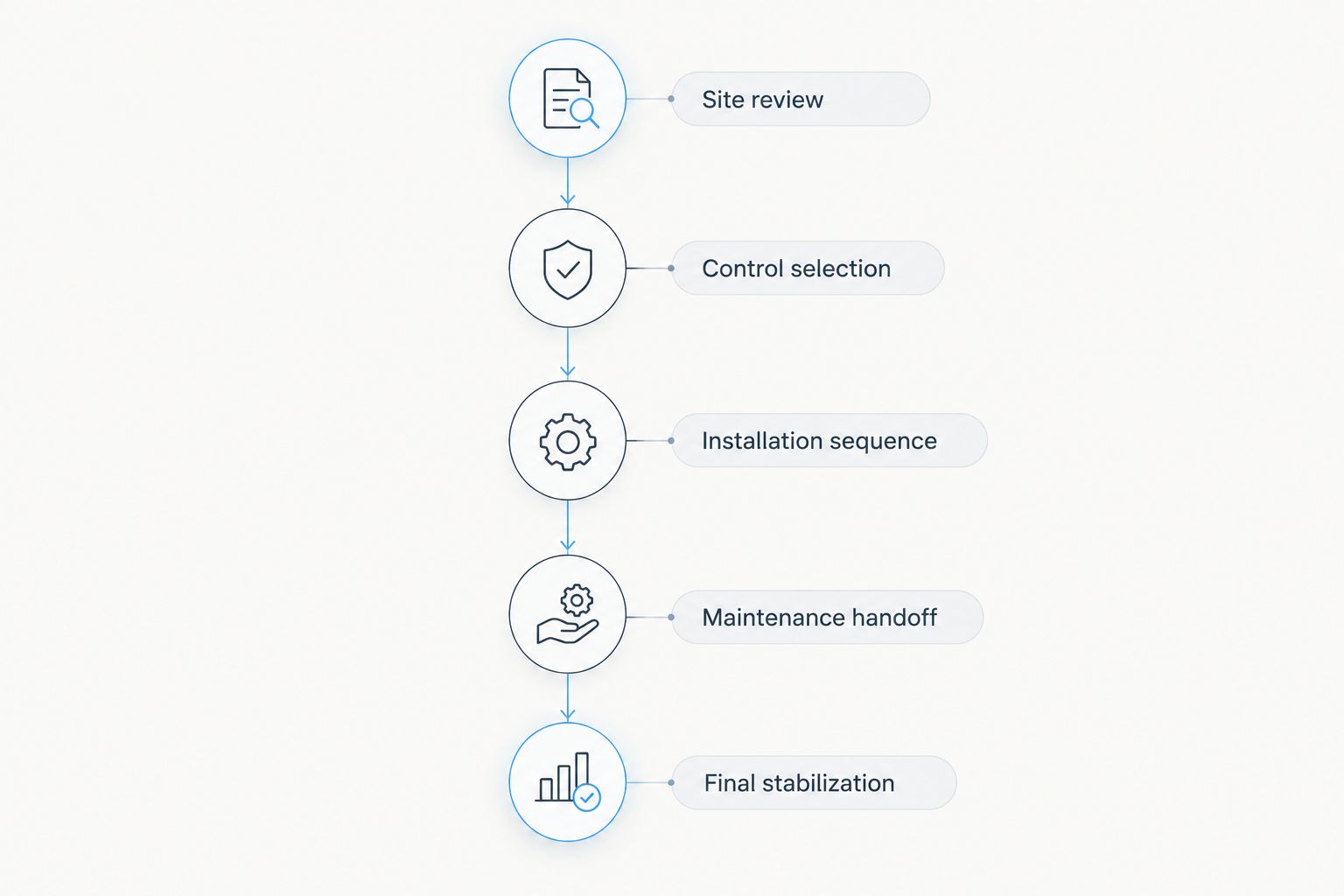
Use this sequence:
- Site review: Identify disturbed areas, incoming water, outlets, access, and nearby drainage features.
- Control selection: Match each condition to a proposed measure and show its location.
- Installation sequence: Identify which controls precede clearing and which change as construction progresses.
- Maintenance handoff: Name who inspects, repairs, and removes accumulated sediment.
- Final stabilization: Define the permanent cover and the conditions for removing temporary controls.
A usable scope also states exclusions. Ask whether seeding, blanket installation, drainage design, inspections, and temporary-control removal belong to the excavating contractor or someone else. Clear exclusions expose gaps before work starts.
Discuss your site preparation scope
Bring your site plan, drainage concerns, and work sequence to a site-specific quote discussion.
Which erosion control methods should you choose?
Start with phased clearing and prompt stabilization, then add controls for the water paths your site actually has. Use blankets for suitable slopes, diversion for incoming runoff, silt fence for sheet flow, inlet protection for drain entry points, and stabilized entrances for vehicle tracking. Add a designed settling area where the drainage plan requires one.
For Ohio work in 2026, confirm applicable stormwater requirements before treating the control list as complete. Federal construction-stormwater permitting generally covers disturbance of 1 acre or more, including smaller sites within a common plan of development that collectively meets the threshold. Ohio requirements and project-specific conditions determine the applicable approval and documentation; a small individual lot does not automatically fall outside permitting.
FAQ
What’s the best erosion control method for a construction site?
Phased clearing paired with prompt soil stabilization is the default starting point. Add controls matched to slopes, runoff paths, drains, and vehicle access rather than relying on one perimeter measure.
Is silt fence better than an erosion control blanket?
Silt fence and erosion control blankets perform different jobs. Silt fence captures sediment from suitable sheet flow, while blankets protect exposed soil surfaces where their specifications fit the site.
Can I use silt fence across a drainage ditch?
Silt fence is not a control for concentrated flow in a drainage ditch. Ask for a measure designed for the channel conditions and an appropriate discharge arrangement.
Does a small residential lot need stormwater permit coverage?
A small residential lot can require coverage when it is part of a larger common plan of development. Federal construction-stormwater permitting generally applies at 1 acre or more of disturbance, including qualifying common plans; confirm the applicable Ohio requirements.
Who maintains erosion controls during construction?
The project scope must name the party responsible for erosion-control maintenance. Specify inspection, repairs, sediment removal, and handoffs between contractors rather than assuming the installer handles every later task.
When can temporary erosion controls be removed?
Remove temporary controls when the applicable plan and requirements allow it after the relevant area is stabilized. Completion of excavation alone does not establish that the controls are ready for removal.
Can Cladlinesw quote grading and excavation for my property?
Cladlinesw provides grading and excavation services from Blanchester, Ohio, across its stated service area. Request a site-specific scope and confirm which erosion-control tasks, drainage decisions, and trade handoffs it includes.
One last thing
A temporary control can remain necessary after the excavator leaves. Finished grading and established ground cover are not the same milestone. Before the final handoff, identify who owns the site condition between those stages and who decides when temporary controls can be removed.
Related guides