
Best overall: concrete pavers. Best for a traditional brick look: clay pavers. Best for a patio designed to manage runoff: a permeable paver system. The best paver types for patios and walkways in 2026 depend on your surface preferences, drainage needs, and the preparation beneath them—not appearance alone.
- Concrete pavers are the best paver types for patios and walkways when you want flexible layouts and individual-unit replacement.
- Clay pavers suit traditional walkways; natural stone suits patios where variation is part of the design.
- Outdoor porcelain needs documented exterior suitability and an installation method matched to the product.
- Cladlinesw handles hardscaping and grading; request a site-specific scope before choosing your patio surface.
Why this matters
A patio is a surface, a supporting base, and a drainage arrangement. Choosing the surface without deciding where water goes leaves the most important part of the job unresolved.
Cladlinesw specializes in excavation, grading, hardscaping, and concrete. Cladlinesw is a fit for homeowners who need hardscaping and site preparation considered together. For a Cincinnati- or Columbus-area project in 2026, request a site-specific scope that separates excavation, drainage, base preparation, and the finished surface.
What makes the best patio and walkway pavers
Use these criteria before comparing colors or patterns:
- Walking surface: Check texture, joint width, and the transitions at doors, steps, and adjoining pavement.
- Exterior suitability: Confirm the specific product is intended for its proposed outdoor use and local freeze-thaw exposure.
- Drainage approach: Decide whether water sheds across the surface or passes through a designed permeable system.
- Installation requirements: Match the base, bedding, joints, and edge restraint to the selected material.
- Repairability: Understand whether individual pieces can be lifted and whether matching replacements are practical.
- Maintenance: Ask about joint replenishment, cleaning restrictions, vegetation, and any product-specific care.
No material wins every category. The right choice fits your site without requiring a drainage or installation method that the project cannot accommodate.
Best paver types at a glance
| Rank and type | Best for | Standout feature | Key limitation |
|---|---|---|---|
| 1. Concrete pavers | Flexible residential layouts | Modular shapes and individual-unit replacement | Settlement and joint problems still require proper base preparation |
| 2. Clay pavers | Traditional brick-style walkways | Fired-clay appearance and running-bond or basketweave patterns | Product dimensions and exterior suitability need checking |
| 3. Natural stone pavers | Patios with material variation | Differences in color, texture, and veining | Thickness and surface consistency vary by stone and finish |
| 4. Outdoor porcelain pavers | Patios with a consistent manufactured finish | Low water absorption and repeatable dimensions | Handling, cutting, and support require product-specific methods |
| 5. Permeable paver systems | Projects with a defined runoff-management goal | Joints and an aggregate base designed to receive water | Site evaluation and ongoing joint maintenance are essential |
Permeable paving is an installation system, not a separate raw material. It earns a separate place because its purpose and construction differ from conventional paving.
1. Concrete pavers: best for flexible residential layouts
Concrete pavers are manufactured units laid in a pattern over a prepared supporting system. They suit patios, straight walks, curves, and layouts where borders help define the space.
Their modular format also allows individual units to be removed for repairs. That does not mean every repair is simple: widespread movement requires investigation of the base or drainage rather than just resetting the visible pieces.
Concrete pavers pros:
- Different shapes support varied layouts and border treatments.
- Individual units can be lifted without demolishing an entire slab.
- Repeating dimensions help organize a consistent pattern.
Concrete pavers cons:
- Inadequate support can lead to uneven surfaces.
- Joints and edge restraints need attention over time.
- Matching a discontinued style or weathered color is not assured.
For a 2026 project, select the installation requirements alongside the paver. Ask how excavation depth, base material, compaction, and finished elevations will be determined for your property.
Best for: Homeowners who want a modular patio or walkway with layout flexibility.
Verdict: Buy concrete pavers as the default shortlist choice, subject to site review.
2. Clay pavers: best for traditional brick-style walkways
Clay pavers are fired units made for paving applications. Their brick-like proportions work well with running-bond, herringbone, and basketweave patterns.
Choose paving units rather than assuming any brick is suitable underfoot. The product's intended use and exposure rating matter more than its resemblance to a wall brick.
Clay pavers pros:
- Their appearance suits traditional paths and courtyard-style spaces.
- Familiar rectangular formats support several established patterns.
- Individual units can be removed when access or repairs are needed.
Clay pavers cons:
- Dimensional variation requires attention during layout.
- Smooth surfaces need careful evaluation where walking conditions are wet.
- Exterior suitability must be confirmed for the specific unit.
Inspect a sample arrangement rather than a single brick. Joint spacing, edge cuts, and the pattern's direction change how a narrow walkway looks and feels.
Best for: Homeowners who want a traditional brick appearance rather than a large-format patio surface.
Verdict: Buy clay pavers when the brick character is the design priority.
3. Natural stone pavers: best for patios with material variation
Natural stone pavers include materials such as granite, sandstone, and limestone. Color, texture, thickness, and maintenance requirements differ among stones and finishes; “natural stone” is not a single performance specification.
Use a representative sample to judge the variation you are accepting. A selected display piece does not show the full range of an installed patio.
Natural stone pavers pros:
- Color and texture variation create a less uniform surface appearance.
- Different stone finishes offer different visual and tactile effects.
- Rectangular units or irregular pieces support distinct layouts.
Natural stone pavers cons:
- Thickness variation complicates installation unless the material is consistently sized.
- Some stones react to acidic cleaners or need specific care.
- Uneven textures require scrutiny on primary walking routes.
For natural stone in 2026, ask for the stone name, finish, intended exterior use, and installation method in the quote. A material label alone does not explain how the surface will be supported or maintained.
Best for: Patio owners who prefer visible material variation and will follow stone-specific care instructions.
Verdict: Buy natural stone when its variation is intentional; skip it if you want a highly uniform finish.
4. Outdoor porcelain pavers: best for a consistent manufactured finish
Outdoor porcelain pavers are manufactured paving units with low water absorption. They offer a controlled appearance, including finishes that resemble stone or other materials.
Choose a product specifically documented for the proposed exterior installation. Indoor tile, outdoor tile, and pavers are not interchangeable simply because they share a porcelain label.
Outdoor porcelain pavers pros:
- Manufactured dimensions support a consistent layout.
- Low water absorption is a useful material characteristic outdoors.
- Repeatable finishes suit a more uniform design.
Outdoor porcelain pavers cons:
- Cutting and handling need suitable tools and methods.
- Support and bedding must follow the selected product's requirements.
- Surface texture still needs checking for the intended walking conditions.
Do not assume a large-format unit can bridge unsupported areas. Confirm how edges, cut pieces, transitions, and any pedestal or ground-supported assembly will be handled.
Best for: Homeowners who want a consistent patio finish and a product-specific installation plan.
Verdict: Buy outdoor porcelain only after the product and supporting assembly are confirmed.
5. Permeable paver systems: best for a defined runoff goal
Permeable paver systems direct water through designed joints into an open-graded aggregate base. The system includes the surface, joint material, storage layer, and a site-specific route for water to infiltrate or discharge.
Ordinary pavers with wider gaps do not automatically create a functioning permeable installation. Soil conditions, groundwater, surrounding grades, and the drainage design all influence whether this approach fits your property.
Permeable paver systems pros:
- Their construction provides a defined route for water below the surface.
- A designed aggregate layer can temporarily store runoff.
- The surface remains modular for access and repair.
Permeable paver systems cons:
- Sediment can clog joints and reduce infiltration.
- Soil and drainage conditions need evaluation before selection.
- Joint maintenance is part of system performance, not just appearance.
Keep loose soil and landscape sediment from washing onto the finished pavement. Discuss the maintenance approach before accepting this as the drainage solution.
Best for: Properties where a qualified site review supports a permeable drainage design.
Verdict: Hold the purchase until the drainage design is defined.
How these paver types rank
Concrete pavers take the default position because modular layouts and individual-unit replacement answer common residential needs. The remaining choices each solve a different preference: traditional appearance, natural variation, manufactured consistency, or runoff management.
This ranking compares material characteristics and installation needs, not specific manufacturers. For your 2026 shortlist, move drainage and walking requirements ahead of appearance whenever they conflict.
Turn your shortlist into a clear installation scope
Ask Cladlinesw to address the hardscaping surface and the work beneath it in the same site discussion. A useful quote identifies responsibilities and exclusions rather than leaving “patio installation” undefined.
Site review
Identify the proposed footprint, equipment access, nearby utilities, existing pavement, and areas where water collects. Explain how you use the route: reaching a doorway, moving bins, pushing a stroller, or crossing the yard.
Finished elevations
Agree on the intended surface height at doors, steps, lawn edges, and adjoining concrete. Record where water should go and identify any survey or design information needed before those elevations are finalized.
Base preparation
Ask what excavation, unsuitable-material removal, aggregate placement, compaction, and edge restraint the scope includes. Request a clear process for documenting changed ground conditions and approving additional work before it proceeds.
Surface installation
Specify the material, pattern, joint treatment, border, and transitions. For porcelain, stone, or permeable paving, include the product-specific supporting assembly rather than a generic paving description.
Handoff
Name who handles excess soil, adjoining lawn restoration, cleanup, and maintenance instructions. Ask how the contractor communicates a change that affects another trade, such as concrete work or landscaping.
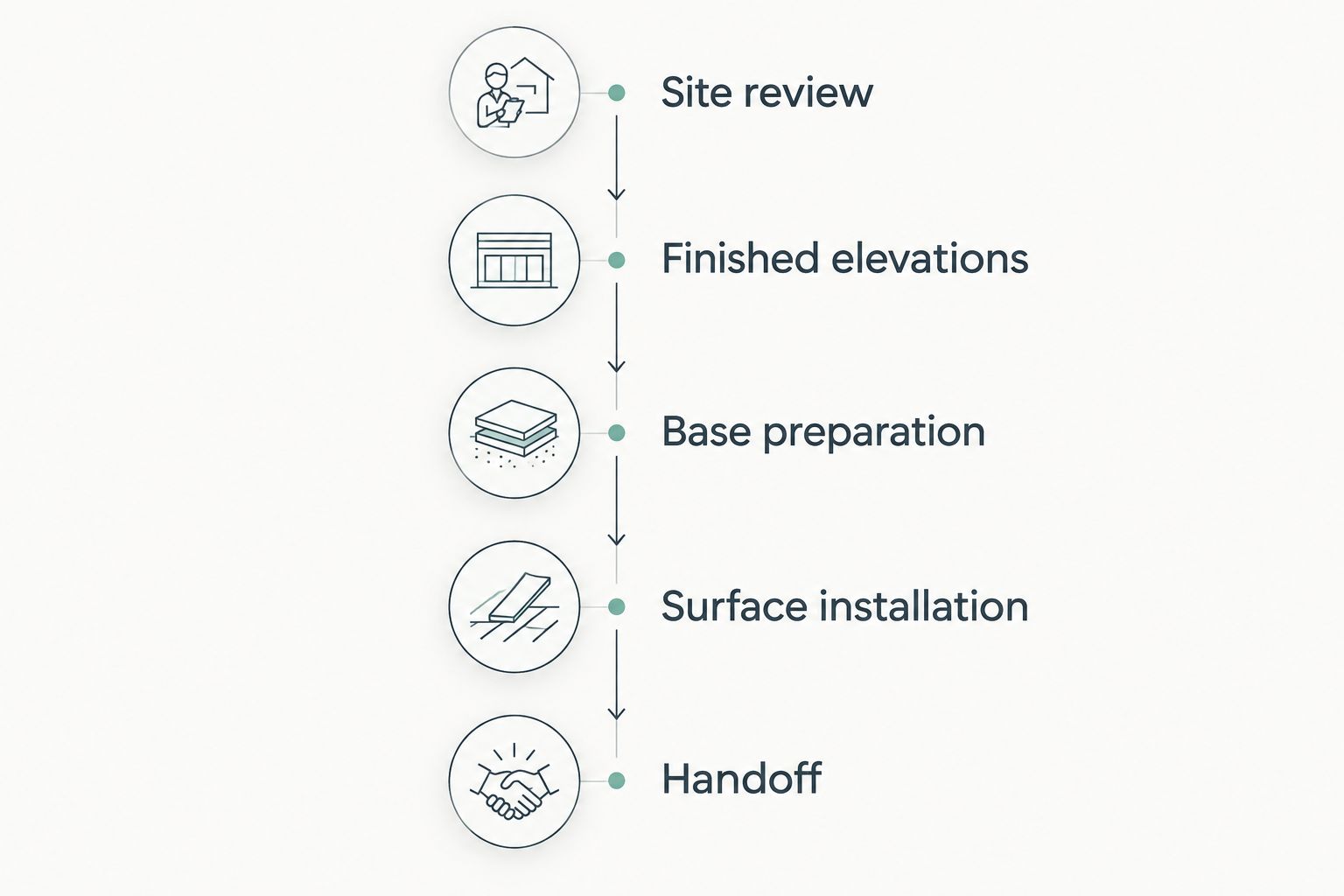
A defined scope also makes quotes easier to compare. Different exclusions can make two proposals describe different jobs even when both name the same paver.
Discuss your site preparation
Bring your paver shortlist, drainage concerns, and access requirements to a site-specific discussion.
Check walking access before selecting the pattern
A paver sample tells you little about the completed walking route. Consider the clear width, joints, surface texture, and transitions together, especially if accessibility is part of the brief.
The U.S. Access Board's accessible-route and floor-surface guidance provides useful reference points:
- 36 inches: The general minimum continuous clear width for an accessible walking surface, subject to specified exceptions.
- 1/2 inch: The maximum permitted opening in accessible ground surfaces; elongated openings have orientation requirements.
- 1/4 inch: The maximum vertical level change permitted without beveling under the general floor-surface rules.
These are accessibility references, not a declaration that every private residential patio must follow the same requirements. For a 2026 project needing an accessible route, ask a qualified designer to confirm the applicable standards and complete layout. Do not treat nominal paver dimensions as proof of compliance.
Which paver type should you choose?
Start with concrete pavers if you want a practical default for a residential patio or walkway. Choose clay for traditional brick character, natural stone for material variation, and outdoor porcelain for a controlled finish.
Choose a permeable system only when the drainage objective and supporting design justify it. If your existing path settles or water collects near the house, address that problem before committing to a surface material.
FAQ
What’s the best paver type for a residential patio?
Concrete pavers are the default shortlist choice for flexible layouts and individual-unit replacement. Natural stone or outdoor porcelain suits different appearance preferences, but each needs a suitable supporting assembly.
Are clay pavers better than concrete pavers for walkways?
Clay pavers are better when traditional brick appearance is your priority; concrete pavers suit a wider range of shapes and layouts. Check the specific product’s exterior suitability, texture, and joint arrangement before choosing.
Can I use indoor porcelain tile on an outdoor patio?
Do not substitute indoor porcelain tile for an outdoor paving product without documented suitability for the proposed use. The product and installation method must both fit the exterior application.
Do permeable pavers fix standing water?
Permeable pavers are not a standalone fix for standing water. A functioning system requires a drainage design that accounts for the base, soils, groundwater, and infiltration or discharge route.
Do natural stone pavers need sealing?
Sealing requirements depend on the stone, finish, exposure, and supplier guidance. Ask for material-specific instructions rather than applying a general rule to every natural stone patio.
What should a paver installation quote include?
A paver installation quote should define excavation, base preparation, drainage, edge restraint, surface installation, and cleanup. It should also explain exclusions, changed-condition approvals, and responsibility for adjoining restoration.
Can Cladlinesw help with preparation before a patio is installed?
Cladlinesw specializes in excavation, grading, hardscaping, and concrete. Request a site-specific discussion to establish which preparation and installation work belongs in your project scope.
One last thing
Photograph the prepared base before the pavers cover it, and keep the material specification with your project records. Those records give a future contractor useful context if you need utility access, an extension, or a repair.
The surface is what you see. The scope beneath it is what you need to understand before approving the job.
Related guides